 Guitar Master
 › Jazz and blues standards
Over 200 jazz standards,
and your blues, played by a band
Band Jam is a band ready to play: choose a jazz standard or a blues, choose the style, and drums, bass and piano (plus organ, percussion or trumpet depending on the style) back you up. You play the melody: Band Jam plays the accompaniment.
The standards
More than two hundred standards, and a band that plays with you, in your key
The great jazz standards, as backing tracks: the form laid out in full (A, A, B, A), transposable into all twelve keys, at the tempo you want, and a band that plays in the style you pick, adjustable musician by musician. You play the head, you improvise, you work on your chords: the band holds down the changes. You can search the standards by title, composer, style or level.
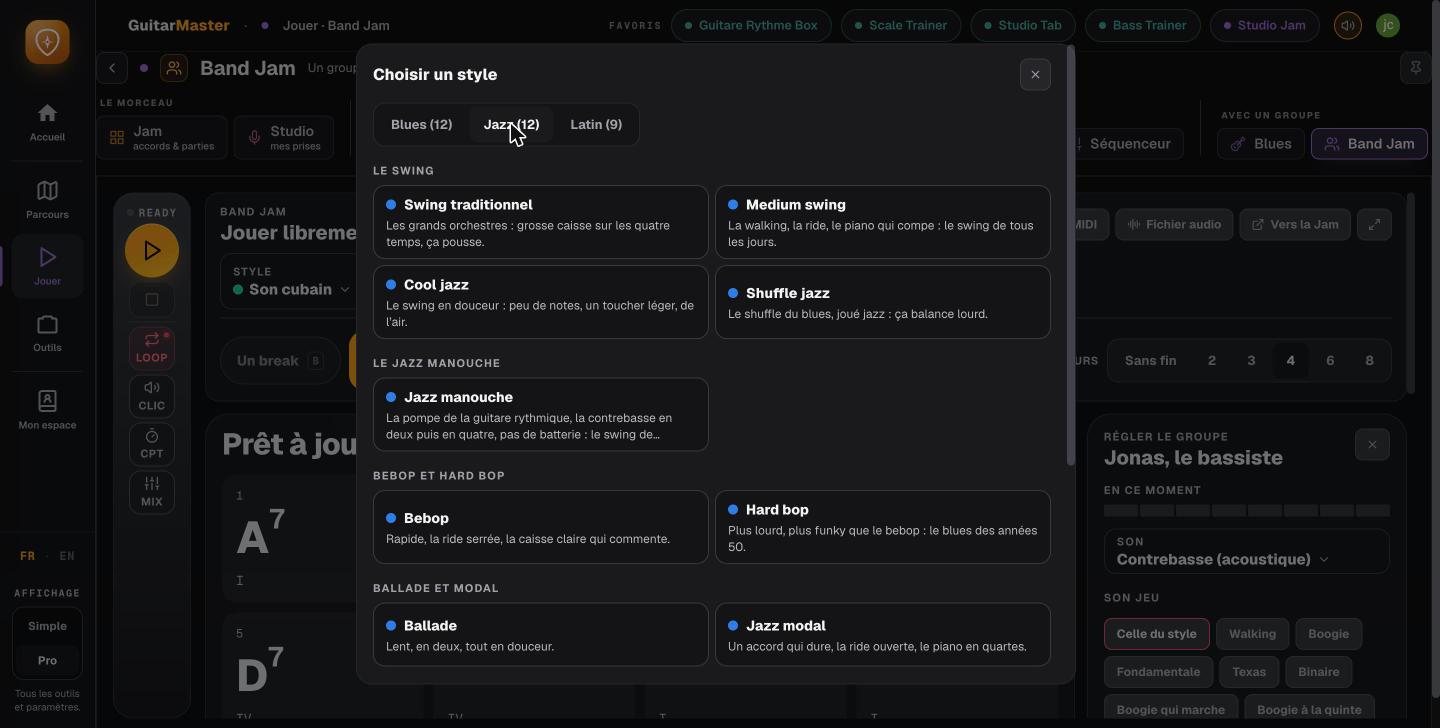
- Medium swing, traditional swing, bebop, hard bop, cool jazz
- Bossa nova, samba jazz, latin jazz, bolero
- Gypsy jazz, modal jazz, jazz funk, ballads
The blues
The blues, in every key
The most-played blues progressions, in the key of your choice, and the styles that go with them: shuffle, boogie-woogie, slow blues, minor blues. The bass player walks or plays boogie, the pianist answers, the organ holds the chords: everything you need to work on the blues as in a real jam.
Your band
Every musician is adjustable
It’s not a recorded loop: each instrument is played live, and you put together your own accompaniment. Change the style, the feel (swing or straight), the pianist and the way he plays, the organ sound, the volume of each musician. Take the band into the Jam to have it on your own songs, or export it as MIDI.
Working on the changes
Every standard becomes an exercise
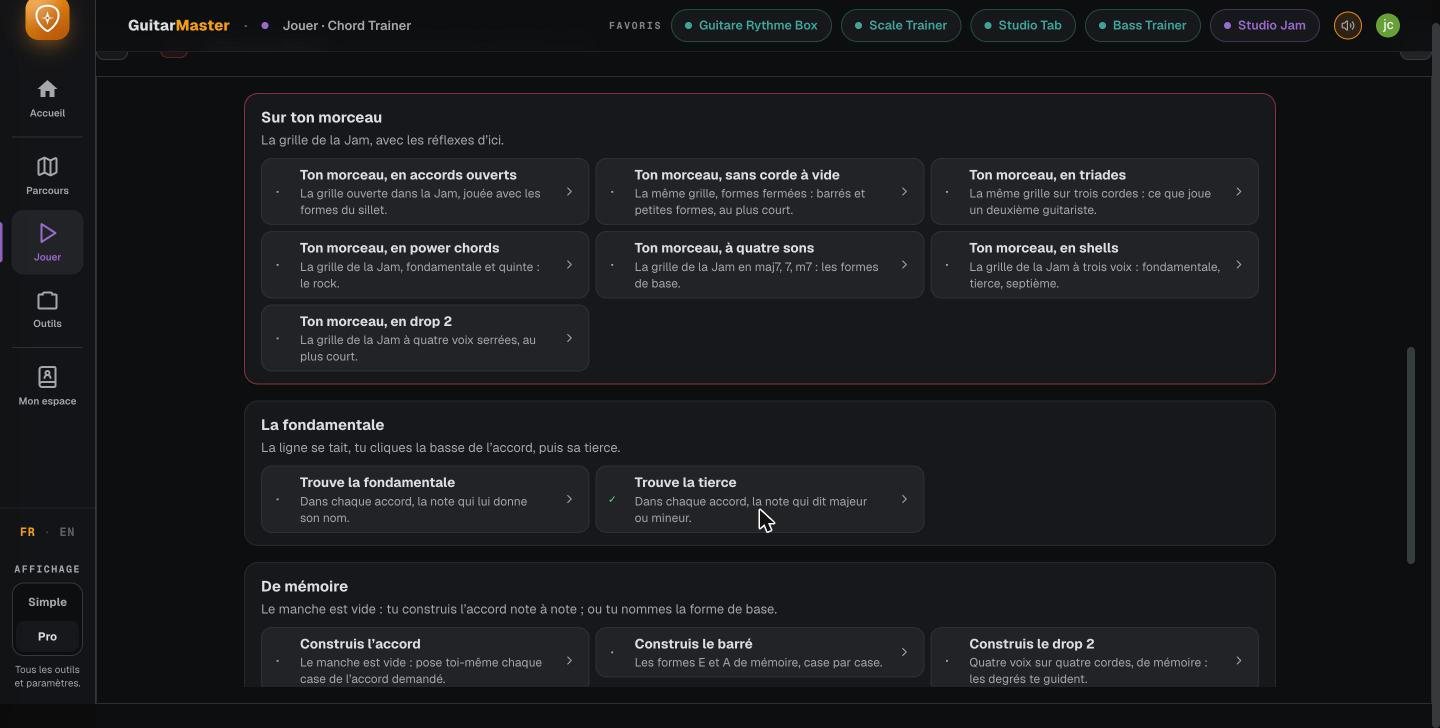
Band Jam’s chord charts open in Guitar Master’s trainers, which write the exercise on them and generate the tab automatically:
- the scales and arpeggios that fit each chord
- triads, four-note chords and voicings, connected with the smoothest voice leading
- the bass line, walking bass included, and the piano accompaniment
- jazz phrases over the changes, and right-hand patterns
- everything on the fretboard, in tab, at a tempo you raise little by little
The blues
The blues, from the Delta to Stevie Ray Vaughan: the stories, and how to play them
Where the blues came from, how it changed from Clarksdale to Chicago, from Dallas to London, and the songs every guitarist ends up playing at jams, with their changes and what to play over them:
- The family tree of popular music : more than a hundred styles and the forty-two tunes from our stories, from the Delta to trap, to explore as a timeline or in 3D
- The history of the blues : from Southern fields to today's stages, the story of a music that learned to sing through the guitar
- Blues styles : from the Delta to blues rock, every accent of the blues, its sound, its records and what it asks of the guitar
- The twelve-bar blues : three chords, twelve bars, and every variation you'll play at a jam
- Cross Road Blues (Crossroads) : a lonely man's blues at the crossroads that became a devil legend, then Cream's jam anthem
- Sweet Home Chicago : the Robert Johnson blues cut in a hotel room that became the chorus of every jam session
- Key to the Highway : the eight-bar blues everyone plays, from Big Bill Broonzy to Clapton and Duane Allman
- Stormy Monday : a Saturday in Hollywood, no written charts, and the slow blues changes everyone ends up playing at the jam
- Dust My Broom : three slide notes that went around the world, born from a boogie played without a bottleneck
- Hoochie Coochie Man : a song slipped to Muddy Waters between sets, a riff, a silence, and the biggest hit of his career
- Hide Away : the tune that has closed blues sets for decades, born in a Chicago club
- Red House : fifteen minutes of studio time, a guitar played as a bass, and the slow blues Hendrix never played the same way twice
- Born Under a Bad Sign : a song written overnight at Stax, and a riff that Cream and Hendrix picked up
- The Thrill Is Gone : the forgotten 1951 blues that made B.B. King a star, thanks to strings added after the fact
- Pride and Joy : boos at Montreux, a studio lent by Jackson Browne: the shuffle that launched Stevie Ray Vaughan
- The Bonamassa generation and the new blues : from Stevie Ray Vaughan to Kingfish's Grammy, how a generation of guitar players relit the blues
The stories
The stories behind the standards, and how to play them
Who wrote these tunes, in what context, how they became standards, then their form, their changes and what to play over them on guitar:
- A Night in Tunisia
- All Blues
- All of Me
- All the Things You Are
- Amado Mio
- Autumn Leaves
- Black Orpheus (Manhã de Carnaval)
- Blue Bossa
- Blue in Green
- Blue Monk
- C Jam Blues
- Cantaloupe Island
- Doxy
- Fly Me to the Moon
- Footprints
- Freddie Freeloader
- Misty
- Oleo
- Satin Doll
- So What
- Song for My Father
- St. Thomas
- Stella by Starlight
- Straight, No Chaser
- Summertime
- Take Five
- Take the A Train
- The Girl from Ipanema
- There Is No Greater Love
- There Will Never Be Another You
- Tune Up
These features are part of Guitar Master’s full access (€14.90 a month, no commitment, opening soon; included for students taking lessons). The core tools stay free for everyone.
Read next
Frequently asked questions
Do the Band Jam standards include the melody?
No. Band Jam plays the accompaniment (drums, bass, piano and, depending on the style, organ, percussion or trumpet). The melody, the head and the improvisation are yours to play.
Which jazz styles are available?
Medium swing, traditional swing, bebop, hard bop, cool jazz, bossa nova, samba jazz, latin jazz, gypsy jazz, modal jazz, jazz funk and ballads, plus the blues styles: shuffle, boogie-woogie, slow blues, minor blues.
Can you adjust the accompaniment?
Yes: the style, the feel, the pianist and the way he plays, the organ sound and the volume of each musician. The band can then play your own songs in the Jam.
How do you practice a jazz standard on guitar?
Start with the changes: the arpeggios of each chord, then triads and voicings connected as smoothly as possible, then the scale for each chord. Guitar Master’s trainers write these exercises on the standard you choose, with the tab and the band backing you up.